Current events


I was planning to post on something else, but with the imminent release of the iPad 3, I decided to write about the phenomenon of unboxing (sometimes referred to as Geek Porn). [Image credit: ntr23]

When a new technological gadget is received, some people video the ‘unboxing event’ and post the video on YouTube. The videos can get millions of hits.

Companies have caught on to the trend and are creating packaging that enhances the experience. And the unboxing fad is a boon to marketing leverage: to drive sales — even before the release of the product — people are paid to create high quality unboxing videos.

But millions of technophiles view the videos for the vicarious thrill, with no intent to purchase.

If you’re curious, check out YouTube for some unboxing videos.

The Earth will pass between the sun and the planet Mars today (Mars opposition), an event that occurs about every twenty-six months. On March 5 (Monday), Mars and the Earth will be at their closest, so this week is a good time to view the Red Planet with the naked eye (is this why the movie John Carter of Mars is opening this week?).

Mars will be visible as a bright orange-red dot in the eastern sky just after sunset; it can be identified as the only celestial object that doesn’t flicker. Mars will slowly rise until it reaches its zenith in the southern sky at about midnight (PST).

If you have a telescope, you should be able to view Mar’s surface features.

The Slooh Space Camera will provide a live-feed of the Mars opposition tonight, beginning at eight o’clock PST.

[Image from the Hubble Space Telescope, found here]

My daughters tell me that I’m one of the last of the dinosaurs who actually listen to the radio, but that’s another story.

I heard an intriguing interview on the way home from work yesterday: the interview was on the CBC’s  DNTO (definitely not the opera) program, and Daryl Davis, author of Klan-Destine Relationships, A Black Man’s Odyssey in the Ku Klux Klan, was the guest.

After Daryl had suffered through his first racial incident, his parents sat him down and explained that some people didn’t like him, and believed him to be inferior, because his skin was dark. He didn’t believe them at first; but, as his experience grew, it slowly dawned on him that his parents were right. He didn’t understand: he couldn’t comprehend why a stranger would dislike and even hate him because of his skin color. He felt sorry for these people; he likened their twisted beliefs to a disease (and the disease traveled both ways: whites against blacks, and vice-versa). So he started studying books on the Ku Klux Klan. He read books filled with interviews, but the interviews were all done by white journalists, and didn’t provide the answers he was searching for.

He decided to write his own book and do his own research: he  interviewed Ku Klux Klan members, without telling them in advance that he wasn’t white. He even attended KKK rallies; cross-burnings.

While he was attempting to understand racial prejudice and gather information for his book, an astounding phenomena occurred: many of the Klan members became familiar with Daryl, changed their views, and rescinded their beliefs.

People can change.

I’m not aware of all the details, but Daryl is thought to be politically incorrect by some white groups, and is called an Uncle Tom by some black groups; however, to me, he sounds like a brave man who is making a difference.

Unofficiallly, the Trinidad Scorpion Morouga is currently the hottest pepper on the planet, although there are some people who are extremely obsessed and this could change anytime soon (or could have already changed; officially, or not). During testing, the Trinidad Scorpion Morouga’s highest rating was slightly over two million Scoville Heat Units (SHU). As a comparison, the hottest jalapeno pepper measures about eight thousand SHU.

[The photo (which looks a bit like the wrinkled face of an old man to me) was found at Fatali’s chiles]

The SHU is a measure of the concentration of capsaicin, which stimulates chemo-receptor nerve endings, particularly those within the mucous membranes.  The SHU scale is named after Wilbur Scoville, who first developed the methodology in 1912. Modern analysis uses high-performance liquid chromatography (HPLC) to determine the capsaicinoid concentration (pure capsaicin has a SHU of 16 million).

It seems that every year there is a new, hotter pepper variety/hybrid.

For years, the reigning champion was acknowledged as the Red Savina pepper, a habanero chili variety that was bred by Frank Garcia (three hundred thousand SHU).

And then the obsession began, and the world saw such champions as: the Dorset Naga, the Bhut (Ghost) Jolokia, the Naga Morich, the 7 Pod Jonah, the Naga Viper, et cetera.

I enjoy my hot sauce, but I’m pretty sure any one of the above peppers is out of my league.

The pistachio (Pistacia vera), originally found in Asia and Asia Minor (from Syria to the Caucasus and Afghanistan), is a small, bushy deciduous tree, which grows to ten meters (30 – 35 feet). The male and female flowers grow on different trees, and the brownish-green flowers occur as a branched cluster.

[Photo found here]

Pistachios usually ripen in September, unless there has been an exceptionally hot summer (in Australia they ripen in February). The hull of the pistachio is referred to as the epicarp, which is a reddish-yellow color while developing, and acquires a rosy, light-yellow tone in August when it begins to ripen. To harvest, a rubber mallet or mechanical shaker is used to cause the nuts to fall onto a sheet. The epicarp is removed within a day of harvesting; the nuts are rinsed in clean, cold water, and then dried. They are then ready to enjoy, although some prefer them salted.

So enjoy World Pistachio Day and have some pistachios today; or tomorrow, or the next day…

The stuff of science fiction…

According to The Daily Yomiuri Online, the Obayashi Corporation, a Japanese construction company, indicated that by 2050 they will construct an elevator to a space terminal thirty-six thousand kilometers above the earth (image found here).

The company will use carbon nanotubes (twenty-times stronger than steel) to reach a quarter of the way to the moon (ninety-six thousand kilometers), where a counterweight will be installed to stabilize and support the structure.

The elevator car will be powered by magnetic motors, travel at two-hundred kph, and have a capacity of thirty people. The journey from earth to the terminal will take seven and a half days.

Solar panels will be installed to power the ground staion.

Last Saturday (February 18), a group of scientists sent a two-stage, suborbital rocket from a research station (Poker Flats, near Fairbanks, Alaska) into the aurora borealis to gather data on the phenomena.

The fish eye photo was taken by Donald Hampton, and I found it here.

The picture was taken as the Terrier-Black Brantt rocket passed through the aurora borealis approximately 350 kilometers into the sky.

Today is Shrove Tuesday.

In Canada, it is commonly known as Pancake Day (or Pancake Tuesday), and in some countries it is known as Fat Tuesday (Mardi Gras)

[image found here]

Shrove Tuesday is the final day before Lent, and it is tradition to eat pancakes or a similar food containing ingredients that are curbed during the forty days of fasting (beginning on Ash Wednesday and concluding on Holy Thursday, the day before Good Friday).

It is also common to forgo one ‘unhealthy’ item/habit during Lent.

The way I see it, this is a sacred sign to eat some sugary, fat food; to enjoy without any associated guilt. Pancakes smothered with butter and syrup sounds pretty good at the moment.

Tonight, in Vancouver, the annual Improbable Research show was held at the AAAS Annual Meeting, which took place in the Mackenzie Room of the Fairmont Waterfront Hotel.

Every year, ten IG Nobel Prizes are handed out to honor achievements in the sciences that sound humorous and generally make people laugh, but then make them think. The awards are presented by Nobel laureates.

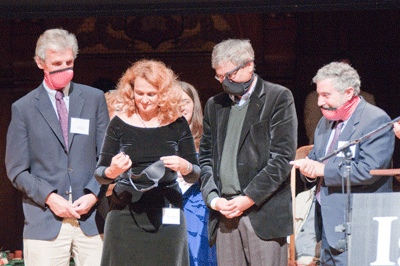
Pictured is Dr. Elena Bodnar, a 2009 Ig Nobel winner, demonstrating her brassieres that convert into a pair of protective face masks. She is being assisted by Nobel laureates (from left to right): Wolfgang Ketterle, Orhan Pamuk, and Paul Krugman. [Photo credit: Alexey Eliseev, from the Improbable Research Website]

Some examples of the prize winners from 2011:

  • Peace Prize: Arturas Zuokas (the Mayor of Vilnius, Lithuania), for demonstrating that the problem of illegally parked luxury cars can be solved by running them over with an armored tank (check out the YouTube Video).
  • Chemistry Prize: Makoto Imai, Naoki Urushihata, Hideki Tanemura, Yukinobu Tajima, Hideaki Goto, Koichiro Mizoguchi and Junichi Murakami for determining the ideal density of airborne wasabi to awaken sleeping people in case of a fire or other emergency, and for applying this knowledge to invent the wasabi alarm.
  • Literature Prize: John Perry of Stanford University, for his Theory of Structured Procrastination.
  • Medicine Prize: Mirjam Tuk, Debra Trampe and Luk Warlop, and jointly to Matthew Lewis, Peter Snyder and Robert Feldman, Robert Pietrzak, David Darby, and Paul Maruff  for demonstrating that people make better decisions about some kinds of things, but worse decisions about other kinds of things‚ when they have a strong urge to urinate.

The 2012 Ig Nobel Prize ceremony will be held on Thursday, September 20, in the Sanders Theater, Harvard University.

If you live in the northern hemisphere, look to the western skies this month, and again in March: there will be some night-sky wonders to view with the naked eye (binoculars will enable a better view, but do not look at the sunset with binoculars: their lenses will focus the sun’s rays and your eyes could be seriously damaged!).

Image credit: inertz.org

During February and March this year, Venus and Jupiter (the most brilliant planets in our night sky) will be the first ‘stars’ to appear in the evening (Venus will be below Jupiter in the western sky).

If you look into the night sky on February 24, you will be able to draw an imaginary line from Jupiter through Venus, past the moon, to Mercury, which should be close to the horizon just after sunset (a little more or less than 30 minutes).

The crescent moon will pass very close to Venus on February 24, 25, and 26.

On February 25 and 26, Jupiter and Venus will be close to the crescent moon in the west and the three spheres will form a tight triangle.

In mid-March (12-15) Venus will be at its highest point in the western sky at sunset; and  it will be bright, and very close to Jupiter (Venus and Jupiter are in conjuction on March 15).

For more information, check out this video

« Previous PageNext Page »