Lists


It’s a few days early for a year’s best-of list, but I’ve got over four-hundred pages left to read in my current book and reading time is scarce at this time of year, so I feel safe claiming which books form the dozen that I’ve enjoyed the most in 2012.

In no particular order, the list:

.

bookSoul Mountain, by Gao Xingjian

Half-Blood Blues, by Esi Edugyan

The Snow Leopard, by Peter Matthiessen

Air (or Have, Not Have), by Geoff Ryman

The Use of Weapons, by Iain M. Banks

Roadside Picnic, by Arkady & Boris Strugatsky

For Whom the Bell Tolls, by Ernest Hemingway

The Sisters Brothers, by Patrick DeWitt

The Map and the Territory, by Michel Houellebecq

The Selfish Gene, by Richard Dawkins

The Road, by Cormac McCarthy

Dhalgren, by Samuel R. Delany

.

.

Merry Christmas, best of the season, and happy reading!

.

.

.


Some of my favorite sounds:

Children playing in the schoolyard across the street.

A church bell

A friendly hello

Heartfelt laughter

Waves massaging the shore

The kree-eee-ar of a red-tailed hawk.

Rain (when I’m inside, reading a good book by the fire)

A cat’s purr

A ‘real’ voice on the phone

A bubbling brook

The car engine starting when I absolutely have to be somewhere

Baseball cards in bicycle tire spokes (a sound I haven’t heard in decades)

.

Image credit: VPL LSCC

I just came across an interesting list: the 25 most beautiful libraries in the world, as ranked by Flavorpill.

I must admit, the thing that most intrigued me was the fact that the Vancouver Public Library’s Central Branch, Library Square came in second (the Vennesla Library and Culture House, in Norway, was in first place).

The Vancouver library was designed by Moshe Safdie & Associates’ Downs/Archambault Partners, and the exterior design —  based on the Roman Colosseum (the Flavian Amphitheater in Rome) — was the most radical design submitted to the City of Vancouver, but the design was embraced by the public, and eventually won the competition.

The exterior has certainly made the library a landmark, but it is the interior, Promenade Square that I enjoy the most: this spacious, glass-roofed concourse serves as the entrance to the library and access to offices and retail space. It’s a lovely place to drink a coffee and enjoy a novel.

My only grievance is that the rooftop garden is not open to the public (I’m still awaiting my private viewing if anybody is reading this and can oblige ;))

I’m back home after a few days away.

After settling in, I made a new playlist and plugged myself in. The music was a bit of a mixed bag, but the pieces left me feeling relaxed.

Traveling is exciting, but coming back home bestows a unique sensation of groundedness.

The playlist:

Evening Song (Phillip Glass: from the opera Satyagraha): from Songs from the Trilogy

Arietta (Edvard Greig): Jan Garbarek from Twelve Moons

New Old Age (John Taylor): Peter Erskine, from You Never Know

September Fifteenth (Metheny-Mays): Pat Metheny & Lyle Mays, from As Falls Wichita, So Falls Wichita Falls

Alone Together (Deitz-Swartz): Chet Baker, from Chet

Do Nothing ‘til You Hear from Me (Ellington-Russell): Joe Pass, from Portraits of Duke

It Ain’t Necessarily So (George & Ira Gershwin): Herbie Hancock, from Gershwin’s World

Idle Moments, Grant Green, from Idle Moments

Parce mihi dominine (Chrisobal de Morales): The Hilliard Ensemble & Jan Garbarek, from Officium

 Knee 1 (Philip Glass: from the opera Einstein On The Beach): from Songs from the Trilogy

 Echoes, Pink Floyd, from Meddle

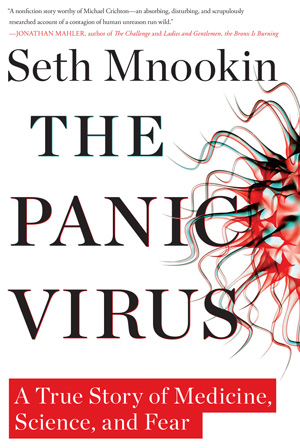
Have you ever wondered how the perception that childhood vaccines cause autism (and other developmental disorders) was started?

Check out The Panic Virus, by Seth Mnookin. I haven’t read it yet, but the publisher’s blurb (which I first saw on i09‘s site) sounds intriguing…

In 1998 Andrew Wakefield, a British gastroenterologist with a history of self-promotion, published a paper with a shocking allegation: the measles-mumps-rubella vaccine might cause autism. The media seized hold of the story and, in the process, helped to launch one of the most devastating health scares ever. In the years to come Wakefield would be revealed as a profiteer in league with class-action lawyers, and he would eventually lose his medical license. Meanwhile one study after another failed to find any link between childhood vaccines and autism.

Yet the myth that vaccines somehow cause developmental disorders lives on . . . In The Panic Virus, Seth Mnookin draws on interviews with parents, public-health advocates, scientists, and anti-vaccine activists to tackle a fundamental question: How do we decide what the truth is?

Also, check out i09’s list of science books for the others that they recommend for the science geek on your shopping list…

The Science Fiction genre was my gateway into the wonders of the novel and this is my official nod to a dozen of my favorite Science fiction works. Some of them are on the list only because of memories; these are marked by * (and, although I have copies of all books on the list, I haven’t read most of them for many years…).

(Image: wikispaces.com)

The Man in the High Castle (1962), Philip K. Dick

Mr. Dick had a remarkable imagination and was a master of blurring the line between reality and the imagination (he was not an effective prose stylist, but I think this novel is his best). The book’s alternate reality premise is that the Germans and Japanese won WWII. Apparently, Mr. Dick used the I Ching extensively to move the plot along; the story delves into the basis of reality, value, and much more. Some find the ending abrupt, but I think it is apropos. Hugo award winner.

Neuromancer (1984), William Gibson

An early shot in the arm for the cyberpunk genre. Neuromancer won the ‘triple crown’ of SF awards: the Nebula, Philip K. Dick and Hugo.

The Left Hand of Darkness (1969), Ursula K Le Guinn

One of the few SF writers that is recognized by the ‘literary’ community. This is not for those seeking a fast-moving plot; the story explores social, psychological, and philosophical issues. An emissary visits a world where the people spend portions of their lives as both male and female. Highly recommended (I would rank Le Guinn’s The Dispossessed slightly higher, but I’ve mentioned it elsewhere, and The Left Hand made an indelible mark when I was younger). Hugo and Nebula awards. (more…)

Below is a list of the songs I listened to on my walk yesterday; mostly country-rock  (and a special thanks to my daughter, Brynne, who gave me her ‘old’ iPod, which makes walks even more enjoyable…):

Return of the Grievous Angel, Lucinda Williams and David Crosby; from Return of the Grievous Angel: A Tribute to Gram Parsons (1999).

New Coat of Paint, Tom Waits, from The Heart of Saturday Night (1974)

Remember the Tin Man, Tracy Chapman, from New Beginnings (1995)

5 Days in May, Blue Rodeo, from Five Days in July (2005)

Hard to Explain, Cowboy Junkies, from Pale Sun Crescent Moon (1993)

Down to the Waterline, Dire Straights, from Dire Straights (1978)

River Runs Deep, J.J. Cale, from Naturally (1972)

Down by the River, Neil Young, from Everybody Knows This Is Nowhere (1969)

Sweet Home Alabama, Lynyrd Skynyrd, from Second Helping (1974)

Peaceful Easy Feeling, Eagles, from Eagles (1972)

Suite: Judy Blue Eyes, Crosby, Stills and Nash, from Crosby, Stills & Nash (1969)

Ripple, Grateful Dead, from American Beauty, (1970)

Some famous last words:

“This wallpaper and I are fighting a duel to the death. One of us has to go”.  Oscar Wilde

“Now, now, my good man, this is no time for making enemies.” Voltaire, when asked by a priest to denounce Satan

“I should never have switched from scotch to martinis.” Humphrey Bogart

“Go on, get out — last words are for fools who haven’t said enough.” Karl Marx, to his housekeeper, who urged him to tell her his last words so she could write them down for posterity.

“I’ve had eighteen straight whiskeys; I think that’s the record…” Dylan Thomas

“I must go in, the fog is rising.” Emily Dickenson

“I just wish I had time for one more bowl of chili.” Kit Carson

“I know not what tomorrow will bring.” Fernando Pessoa

“They couldn’t hit an elephant at this distance.” General John Sedgwick

“All my possessions for a moment of time.” Elizabeth I

“Dying is a very dull and dreary affair; and my advice to you is to have nothing whatever to do with it.” W. Somerset Maugham

“I can’t believe, after all this time, it was a bloody banana that killed me.” Ivanka Perko

Bamboozle

Cockamamie

Diphthong

Discombobulate

Flibbertigibbet

Hobnob

Hornswoggle

Kerfuffle

Kumquat

Persnickety (also Pernickety)

Popinjay

Quagmire

Scuttlebutt

Shenanigans

Titillate

A short list of some excellent jazz music. The cuts are listed chronologically, except for A Love Supreme, which I had to put last, because whenever I listen to it I’m unable to listen to anything else for a while.

Night in Tunisia, Stan Getz, from West Coast Jazz, 1955

 Blues Walk, Lou Donaldson, from Blues Walk, 1958

One for Daddy-O, Cannonball Adderly, from Something Else, 1958

Moanin’, Art Blakey and the Jazz Messengers, from Moanin’, 1958

 Take Five, Dave Brubeck Quartet, from Time Out, 1959

 Freddie Freeloader, Miles Davis, from Kind of Blue, 1959

Bolivar Blues, Thelonius Monk, from Monk’s Dream, 1963

Question and Answer, Pat Metheny, from Question and Answer, 1989

Lennie’s Pennies, Charlie Haden, from Quartet West, 1991

Afro Blues, John McLaughlin, from After the Rain, 1995

‘Ques Sez, Garry Burton, from next generation, 2005

A Love Supreme¸ John Coltrane, from A Love Supreme, 1965

Next Page »