Music


We were driving along the Fraser Highway, on our way to pick up our eldest daughter, Bailey. I’d turned the radio down because we were discussing Cat’s idea for a used bookshop/coffeehouse…

Cat: “…and we’ll display the works of local artists.”

Me: “You should be clear with the artists that you’ve got ‘particular tastes‘: you’ll want to be able to give them a polite ‘no thanks.’ After all, you don’t want dogs playing poker, do you?.”

Cat (mostly ignoring me): “…and poetry readings…maybe even some beatnik poetry.”

Me: “I suppose you already have a guitar-player lined up for Opening Night?

Cat: Nodded and said, “Yup: Jim Cuddy.”

We  both sat in silent contemplation. I turned up the radio; and, after listening for a half-minute, it slowly dawned on…

Me: “Is that Jim Cuddy? Did you mention him because his song is on the radio?

Cat: “No I didn’t. But I think that is Jim Cuddy.”

It was Everyone Watched the Wedding, from his new album.

Maybe something clicked subliminally in Cat’s mind as the music played quietly, but the music had been almost inaudible. Perhaps it was synchronicity. I doesn’t matter. I’m going  to buy the CD when I get a chance…it will be perfect background music in her shoppe.

I’m back home after a few days away.

After settling in, I made a new playlist and plugged myself in. The music was a bit of a mixed bag, but the pieces left me feeling relaxed.

Traveling is exciting, but coming back home bestows a unique sensation of groundedness.

The playlist:

Evening Song (Phillip Glass: from the opera Satyagraha): from Songs from the Trilogy

Arietta (Edvard Greig): Jan Garbarek from Twelve Moons

New Old Age (John Taylor): Peter Erskine, from You Never Know

September Fifteenth (Metheny-Mays): Pat Metheny & Lyle Mays, from As Falls Wichita, So Falls Wichita Falls

Alone Together (Deitz-Swartz): Chet Baker, from Chet

Do Nothing ‘til You Hear from Me (Ellington-Russell): Joe Pass, from Portraits of Duke

It Ain’t Necessarily So (George & Ira Gershwin): Herbie Hancock, from Gershwin’s World

Idle Moments, Grant Green, from Idle Moments

Parce mihi dominine (Chrisobal de Morales): The Hilliard Ensemble & Jan Garbarek, from Officium

 Knee 1 (Philip Glass: from the opera Einstein On The Beach): from Songs from the Trilogy

 Echoes, Pink Floyd, from Meddle

The Canadian Broadcasting Corporation (CBC) is celebrating its 75th anniversary today. I’ve never watched much CBC TV (except for Hockey Night in Canada, of course), but their FM radio programs (now referred to as CBC Radio 2) were my companions for twenty years while commuting to work and back; in fact, I garnered a fair comprehension of classical and jazz music during the commutes. I don’t listen to CBC radio as much as I used to (the programming has changed, I suppose to appeal to a younger audience), but I fully appreciate the music I was exposed to for those lonely trips to work and back.

Congratulations to the CBC on 75 years of quality programming!

Click on the Logo to see CBC’s Logo retrospective…

The theremin (named after its inventor, Léon Theremin) is played without physical contact; sound is produced by the movement of hands in the proximity of two antennae. Frequency (pitch) is manipulated by the distance of a hand from one antenna, while amplitude (volume) is controlled by the distance of the other hand to the second antenna.

Apparently, the theremin is simple to learn, but mastery is difficult. There is no feedback guidance; no valves, keys, frets, or fingerboard positions. Another challenge is minimizing portamento; the carriage, or slurring, when sliding from one frequency to another.

Have a listen to Lydia Kavina* playing Claire de Lune 

*Lydia Kavina is the grandniece of Léon Theremin.

It was was many years ago; a rare occurrence, when life became buoyant and time passed in leisurely, elongated moments….

I was listening to a live concert on CBC radio (FM): it was Mozart’s Bassoon Concerto in B flat major (K. 191). I was listening though headphones and the microphone must have been very close to the bassoonist because I could hear the valves of the bassoon clacking: it was quite audible. After a few moments — my attention being drawn again and again to this noise — the valves began to sound less like the clacking that my novitiate senses had erroneously detected, and rather more like a moist, measured schplading. I became more intrigued each moment and looked forward with increasing enthusiasm to the next bassoon solo. My mind was eventually filled with an image of penguins playfully pattering about on damp tiles. The image conveyed gave the piece a whimsical quality that I was sure Mozart intended. I was completely convinced a few weeks later when I came across a song by Mannheim Steamroller entitled Wolfgang Amadeus Penguin

I like to listen to music with textures, or layers; what I like to think of as dimensions.

Most popular music has a catchy melody, but is two-dimensional; flat.

Really good music has depth, a third dimension.

Sublime music has deeper levels; obscure textures in higher dimensions.

The eminent classical composers knew it (or it was innate within them), many jazz artists figured it out, and some rock musician/composers explored the deeper layers of musical form, but most popular bands miss the mark.

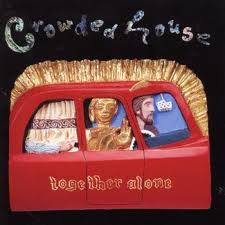
I just listened to Alone Together (1993) by Crowded House (which includes members of Split Enz). The group understands layers, but stumbled slightly on the danger that can materialize from this knowledge: overproduction.

They know how to write melody and create texture, but the sound is too clean and calculated (for my tastes); however, I really did enjoy the CD, and I’d recommend having a listen.

Below is a list of the songs I listened to on my walk yesterday; mostly country-rock  (and a special thanks to my daughter, Brynne, who gave me her ‘old’ iPod, which makes walks even more enjoyable…):

Return of the Grievous Angel, Lucinda Williams and David Crosby; from Return of the Grievous Angel: A Tribute to Gram Parsons (1999).

New Coat of Paint, Tom Waits, from The Heart of Saturday Night (1974)

Remember the Tin Man, Tracy Chapman, from New Beginnings (1995)

5 Days in May, Blue Rodeo, from Five Days in July (2005)

Hard to Explain, Cowboy Junkies, from Pale Sun Crescent Moon (1993)

Down to the Waterline, Dire Straights, from Dire Straights (1978)

River Runs Deep, J.J. Cale, from Naturally (1972)

Down by the River, Neil Young, from Everybody Knows This Is Nowhere (1969)

Sweet Home Alabama, Lynyrd Skynyrd, from Second Helping (1974)

Peaceful Easy Feeling, Eagles, from Eagles (1972)

Suite: Judy Blue Eyes, Crosby, Stills and Nash, from Crosby, Stills & Nash (1969)

Ripple, Grateful Dead, from American Beauty, (1970)

A short list of some excellent jazz music. The cuts are listed chronologically, except for A Love Supreme, which I had to put last, because whenever I listen to it I’m unable to listen to anything else for a while.

Night in Tunisia, Stan Getz, from West Coast Jazz, 1955

 Blues Walk, Lou Donaldson, from Blues Walk, 1958

One for Daddy-O, Cannonball Adderly, from Something Else, 1958

Moanin’, Art Blakey and the Jazz Messengers, from Moanin’, 1958

 Take Five, Dave Brubeck Quartet, from Time Out, 1959

 Freddie Freeloader, Miles Davis, from Kind of Blue, 1959

Bolivar Blues, Thelonius Monk, from Monk’s Dream, 1963

Question and Answer, Pat Metheny, from Question and Answer, 1989

Lennie’s Pennies, Charlie Haden, from Quartet West, 1991

Afro Blues, John McLaughlin, from After the Rain, 1995

‘Ques Sez, Garry Burton, from next generation, 2005

A Love Supreme¸ John Coltrane, from A Love Supreme, 1965

Before I wandered into the worlds of jazz and classical music the records below were some that I enjoyed the most, and I still enjoy listening to all of the music listed (in no particular order):

Little Feat, Dixie Chicken (1973)

J.J. Cale, Naturally (1972)

Dire Straits, Communiqué (1979)

Z Z TopTres Hombres (1973)

Crosby, Stills & Nash, Crosby, Stills & Nash (1969)

Elton John, Madman Across the Water (1971)

Led Zeppelin, Led Zeppelin II (1969)

Pink Floyd, The Dark Side of the Moon (1973)

Neil Young, Everybody Knows This is Nowhere (1969)

The Rolling Stones, Let it Bleed (1969)

Santana, Abraxas (1970)

Steely Dan, Countdown to Ecstasy (1973)

Check out these takes of Queen’s Bohemian Rhapsody and B-52’s Rock Lobster

« Previous Page