Following is a short review of Riddley Walker, by Russell Hoban; for a slightly more in-depth look, check out my post at Retrospeculative

Riddley WalkerRiddley Walker is a struggle to read; some people might find that reading sections out loud helps, and it was designed that way, written in phonetic vernacular, with a British accent in mind (and, to be specific, an accent from the county of Kent). Punctuation is ignored, with the exception of periods. There is a limited vocabulary; so, as the reader progresses through the novel, it becomes easier to decipher the text, a first-person narrative by the protagonist, Riddley Walker, who is considered a literate man in his world although he is only twelve years old.

The book is written in a manner that forces the reader to slow down in order to demystify the story; just as Riddley Walker must slowly puzzle things out for himself (by the way, the names of characters in the book are representations of their personalities: Riddley Walker, Fister Crunchman, Abel Goodparley, etcetera). I assume that the book was purposely written so that the reader is forced to sound some sections aloud in order to comprehend the meaning; in Riddley’s world, information is shared orally, and Riddley’s writings form the possibility of a re-invented media.

The reader soon realizes that the events take place in England (‘Inland’) sometime after an apocalyptic, nuclear event (it is stated in the novel that over 2,400 years have passed since the apocalypse, but that seems too long a time for the slight degradation in language; after all, it is still recognizable. There are many misguided ‘facts’ within the novel and I suspect that less time has passed than what is stated). Riddley’s world is slowly revealed through the mists of confusion: there are struggles between agricultural groups and hunter-gatherers, wild dog-packs terrorize the countryside, and the government distributes its politico-mythic messages using portable puppet theatres (politically revamped Punch and Judy shows).

The plot is interesting, but much of the enjoyment comes from untangling the language; it immerses the reader, who must ‘riddle’ things out as s/he ‘walks’ through the story.

There is a short glossary at the end of the book, but if you’d like some further help while reading, the sites listed below are useful (I found that reading a chapter and then perusing the annotations, while flipping through the pages of the chapter again, solidified the story).

Recommended; but be forewarned, it is probably not a novel to take for a casual read on the beach this summer.

.

A couple of resources (that also contain links to other resources):

Riddley Walker Annotations: with chapter-by-chapter notes and much more.

Russell Hoban’s official website

.

.

.

Esi Edugyan’s Half-Blood Blues follows the narrator, bassist Sidney (Sid) Griffiths, in Berlin and Paris at the beginning of WW II (1939 – 40) and in the early 1990s when he and his friend — drummer Chip Jones — travel to Poland to meet their long-lost band mate, trumpeter Hieronymous (Hiero) Falk.

Half-Blood Blues is about the pursuit of art in the miasma of racial bigotry, war, friendship, love, loyalty, jealousy, fear, and betrayal.

Sid, a mediocre bass player, is carried along in the wake of a talented jazz band; but, when Hiero joins the band, Sid becomes resentful of the young man’s genius. Sid is also jealous of the attention that his love-interest gives to Hiero (it is a sisterly love, but Sid is naive and insecure).

In the sections dealing with the past (1939-40) Sid’s narration is the melody, and the racial tensions of the burgeoning war pulse with a rhythm that drives the story forward.

When Sid is an elderly man (1992) his narration weaves hints of a betrayal that occurred in the past (selfish treachery, but not designed to cause the tragedy that ensues), which becomes clearer as the novel progresses. Sid almost gained significance in the history of jazz music, but he is haunted by an incident that took place during the war-torn years.

Esi Edugyan writes wonderfully, with many vivid portrayals of jazz music, yet some passages that mingled rough vernacular and smooth narration didn’t work for me. But the novel, as a whole, is a wonderful read.

Recommended.

“His great novel Soul Mountain is one of those singular literary creations that seem impossible to compare with anything but themselves.” From the Nobel Prize for Literature (2000) press release.

Soul Mountain is a major work from Gao Xingjian, but if you plan on reading it, be forewarned: an excursion through the novel is an unconventional experience. There is  no protagonist, significant character, plot, or story arc. And there is — at best — a tenuous temporal structure to the narrative. There are certainly themes running through the book, and it is part travelogue, part autobiography, part philosophical musing, and part several other things. Most importantly, it provides a rich, rewarding encounter.

The novel is fragmented, creative, and disjointed, yet — ultimately — it is remarkably cohesive. The book itself is Soul Mountain, and Gao Xingjian is our guide. We have been invited inside his psyche, a gyring caldron of stories, thoughts, history, recollections, folklore and dream visions. 

The unnamed narrator — Gao Xingjian, in one guise or another — is escaping the grasp of the city, its politics, and regime. He is leaving with freedom of spirit, a newfound lease on life after a misdiagnosed lung cancer scare. He sets out on a spiritual journey to find the mythical Soul Mountain (Lingshan); unfortunately, morbidity is a side-effect of his solitary quest. He meets with others on his travels, but more often encounters loneliness, so he invents characters, versions of his own psyche (I, You, Him, Her, He, She…) to keep him company, to share his thoughts and stories with, to travel with, and to truly connect with (though this, too, is not completely successful. And it seems that the reader, too, is the you, she, he, her and him within the pages). It is sometimes challenging to focus on the narrative as it meanders down unsuspected paths; and, though I treasured many sections, I was impatient with the burden of others. But “The true traveller is without goal, it is the absence of goals which creates the ultimate traveller.” (chapter 47, p. 277).

I found the reading experience thought-provoking, but I’m not sure I can recommend it as a novel (at one point, the author critiques himself: “This isn’t a novel!”, chapter 72, p. 452). However, if you are a patient reader that is searching for something different (at times frustrating), and something that — as much as I’ve tried — defies description, then I highly recommend a journey through Soul Mountain.

While reading the novel I also flipped through a book of Gao Xingjian’s ink paintings, Return to Painting. The paintings, and the Zen-like writings in this book, add a further dimension to his novel, and I recommend a look at his art while reading the novel (some of his paintings can be found here and here).

There is even a painting within Return to Painting entitled Soul Mountain (64.2 x 46 cm, 2000. Private collection).

This book’s story is presented with a science fiction (time travel) veneer, but it is really about: how we regard time and how it affects us (“we are all time machines”), family dynamics, and literary theory. The writing is quite witty in spots (at times the protagonist reminded me of Stanislaw Lem’s Ijon Tichy, from The Star Diaries), but the author has a tendency to  belabor a point (smilar to the regressive loops contained in the story). The book is short (slightly over 200 pages), but I felt that the author could have presented his ideas in an even shorter form.  


I enjoyed the book, and recommend it to anyone who appreciates an easily accessible, fictional ‘thought experiment.’

The Yiddish Policemen’s Union is an alternate history, noir murder mystery novel by Michael Chabon. The novel is set in present day, but is based on the premise that a temporary settlement for Jewish refugees was established during World War II in Sitka, Alaska, and the State of Israel collapsed soon after the novel’s alternate version of the Arab-Israeli War. The novel is sprinkled with many other differences from our own world, but they are described as background references, and the focus of the story is on the city of Sitka, a Yiddish speaking metropolis encroaching on Tlingit First Nation’s Lands.

The main character, Meyer Landsman, is a bit of a nebbish (click the more… tag below for a small Yiddish ‘dictionary’ that may be useful when reading the novel), but stumbles his way through a murder case that becomes a personal odyssey, as it ultimately connects with the death of his beloved sister.

The world that Chabon weaves — his alternate version of Sitka Alaska, with its mixed populace of Jewish and Tlingit First Nation peoples — is rich and believable.

Highly recommended.

(more…)

Motherless Brooklyn, by Jonathan Lethem, is equal parts hard-boiled detective novel and postmodern literature, with a narrator who is afflicted with Tourette’s syndrome.

The main character (and narrator), Lionel Essrog, is unforgettable.

The novel is fast-paced and witty, Lionel is a likeable, sympathetic character, the dialog is inventive, and — although effortless to read — there is a remarkable humanistic depth inherent in the story.

An excellent novel: recommended.

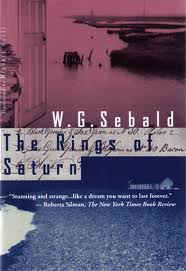
The Rings of Saturn* is ostensibly the record of a walking tour along the eastern coast of England, but it spins fascinating threads, including: black and white photographs, history, people, places, beauty, decay, life, destruction, and death.

It is a novel, but contains more than a hint of an autobiographical account.

The narrative feels like a gathering of objects; the threads of a man’s thoughts, as an act of immortality.

At times I found the novel frustrating, but I persevered, and it is one of the  most extraordinary books I’ve read.

Highly recommended.

*by W.G. Sebald [translated from the German by Michael Hulse]

A Woman in Jerusalem, by A.B. Yehoshua [translated from the Hebrew by Hillel Halkin]

This is a deceptively simple story that is filled with symbolic echoes. A woman — Yulia Ragayev, a Russian expatriate — is the victim of a suicide bombing in Jerusalem. The company who employed her is accused of inhumanity, and an unnamed human resource manager is assigned the task of resolving the situation.

The resource manager becomes obsessed with Yulia’s identity; her individuality, the meager possessions in her home, and her social relations. He is irrevocably changed by his investigative interaction with the dead woman and those who knew her.

An ominous mood of Jerusalem is portrayed, as is its humanity and compassion.

The resource manager goes on an epic journey; the reader is taken along and — if receptive — is also changed.

An excellent novel: I plan to re-read this book in a few years; I think I’ll enjoy it even more the second time.

Recommended.

The Makioka Sisters, by Junichiro Tanizaki, was translated from the Japanese by Edward Seidensticker. The Japanese title, Sasameyuki, means ‘light snow’ and evokes an image (in poetics) of cherry blossoms falling in spring, denoting impermanence, a major theme in the novel. Notably, one of the Makioka sisters is named Yukiko; the yuki in her name, as in the Japanese title, means snow.

This is not my favorite type of fiction (i.e.: the interaction of three (sometimes four) women), but I found myself warming to the novel as I journeyed through the pages. It is a melancholy story, which focuses on the decay of the Makioka family status just prior to World War II. The impermanence of life is represented, in part, by the deterioration of traditions, the annual outings to experience the cherry blossoms, illness and death, and Sachiko’s unhappiness at the eventuality of ‘losing’ her sister — Yukiko — to a husband.

A lasting image from the novel is of the three youngest sisters (Taeko, Yukiko, and Sachiko) dressed in kimonos and strolling through the shrines to view the cherry blossoms, while tourists snap pictures of the three women (some of whom asked permission; others, impolitely, did not).

It was a bittersweet book to finish and, as I closed the cover, it was as if the final cherry blossom had fallen to the ground (and now I’ll have to de-emasculate myself by reading some Hemingway (or his ilk)).

Recommended

I just re-emerged from The Frank Book by Jim Woodring. I first saw his work — Frank’s Real Pa — in The Millennium Whole Earth Catalog (1994; part of The Whole Earth Catalog compendium, well worth several hours of perusal); the comic ran, one panel at a time, on the bottom, right hand corner of each odd page (starting on p. 7).

The Frank Book contains a collection of dream-like panels that appear to be commonplace at first glance, but reveal a phantasmal, alternate reality.

Highly recommended.