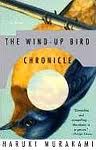
 Haruki Murakami has become one of my favorite authors; he isn’t for everyone’s tastes, but The Wind-Up Bird Chronicle feels like a book he was working toward for years. Most of his usual themes are present, as is his ubiquitous protagonist; the lonely, thirty-something male, who allows outside influences to guide him through life.
In this novel, Toru Okada loses his job, his cat, and his wife; he searches for the latter two, and opens his world to an extraordinary array of characters, stories, and situations.
There are several threads within the frame of the narrative, some of which remain unresolved to the satisfaction of a few reviewers; however, I found the novel eminently satisfying. I’ve encountered many complaints about extensive cuts in the translation from Japanese to English, and counter-claims (some from the translators) that the Japanese edition was poorly edited. Whatever; I enjoyed it.
There are frustrating sections, and disturbing scenes and moods, but there is a prevailing atmosphere of hope within the beat of its metaphysical heart.
The Wind-Up Bird Chronicle won the prestigious Yomiuri Prize (1995) for Literature: the recipient receives a million Japanese yen and an inkstone (the prize was awarded by Oe Kenzaburo, one of Murakami’s harshest critics).
Highly recommended.
Haruki Murakami has several other exceptional novels (e.g.: Kafka on the Shore, Hard-Boiled Wonderland and the End of the World, Norwegian Wood, etcetera…), and, sometime, I’ll give a quick review of them. Have a look at the author’s site
 db johnston
 almost falling