lakeheader6

A couple of months ago I posted about the beginning of a journey to find the slim man inside of me.

Since then, I’ve been walking everyday, practicing qigong, and generally trying to eat a more healthy diet. My goal was to lose weight gradually, but noticeably.

I’m beginning to recognize the man who looks back at me in the mirror, someone I haven’t seen in years. It was difficult at the beginning, but I’ve managed to form healthy, habitual behaviour.

I’ve lost a little over seven kilos (more than 15 pounds) and I feel better than I have in a long time. I’m just now realizing how much extra weight I’ve been packing around, because I’d like to lose another 5 kilos, if not more.

When I began my journey I assumed that, if I spent an extra hour a day exercising, I’d find less time to do the things I enjoy; in particular, reading. And I was right, but in a way I hadn’t envisioned. I’ve spent more time doing other things I enjoy, like writing a novel, and organizing our home: things I’d been ignoring for far too long. Who would’ve thunk?

Anyway, if your interested, I’ll let you know how I’m doing in 2014, after my annual Christmas/New Year gluttony period. For a while, I was worried about the winter weather and how it may put obstacles in the path of my walking regime, but I’ve decided to prepare for that by starting a serious foray into a tai chi chuan form (the 108 posture Wu style, with Yang influences) that I was taught over twenty years ago, a magical exercise that I can adapt to the confines of our condo.  If one pathway is blocked, other avenues open.

Life is filled with twists and turns, an amazing journey.

.

.

.

I’ve listed a few points below that are useful to know (the numbers in brackets  correspond to the numbers in the diagram):

Bai Hui (1):

The Crown Point of your head. While doing taijiquan, standing postures, or during meditation, you should feel as though you are suspended from above by  the bai hui. The bai hui is an important fifth gate in regulating qi (along with the lao gong (palm) and yong quan (sole of the foot)) .

Jian Jing (2):

The Shoulder Well. Relax your shoulders; let them sink, but not slump. Many of us have a tendency to hold tension in our shoulders. To become aware of  the difference between tension and relaxation, lift your shoulders — really stretch them upward — to your ears and then let them slowly sink.

Qu Chi (3):

Pool at the Bend

Zhong Fu (4):         

The Middle Mansion: the spongy region between the shoulder and chest. Do not push the chest out or collapse it: discover equilibrium by relaxing your chest and liberating tension from your upper body.

Qi Men (5):              

The Cyclic Door. This region will become tense if you breathe into your chest; consciously breathe into your belly, let the abdomen expand and contract, pulling your diaphragm down, which relaxes the rib cage downwards and in towards the spine.

Zhang Men (6):

The Bright Door. Relax and keep this region elastic. Abdominal breathing relaxes this region.

Ming Men (7):

Life’s Door (or The Life Gate): located on the mid-line of the lower back (within the small of your back), this is the center of prenatal chi or innate life-force.

Qi Hai (8):

Sea of Qi: an important meridian point in the conception vessel.

Qi Chong (9):          

The Qi Pouring (kua). Relax into your pelvis — the inguinal crease — and sink downwards as if you are lowering yourself onto a stool directly beneath you. Do not tuck your pelvis; rather, find equalibrium between tipping forward and sticking your rear backwards. As you sink into this point, and into the inguinal crease (the kua) try to sense that your ming men region (the small of your back) has flattened outward.

Lao Gong (10):

Palace of Toil (interestingly, lao gong also means husband in  Mandarin: do women have men in the palm of their hands?). Located where the tip of the middle finger falls when a loose fist is made. A major gate where the body’s qi is regulated.

Hui Yin (11):

Meeting of Yin: located in the center of the perineum (males: in between the anus and the scrotum; females: between the anus and the posterior labial commissure).

Chang Qiang (12):

Long Strong: located Midway between the tip of the coccyx bone and the anus.

Huan Tiao (13):

Jumping Round

Feng Shi (14):

The Wind Market. When performing standing meditation, the feng shi point is at the tip of the middle finger.

Wei Zhong (15):

Bend Middle (or The Popliteal Center). Bend your knees slightly. Maintain an arch between your legs. The knees should not be turned out.

Yong Quan (16):

The Bubbling Well. Center your body weight over this point, which is just behind the ball of the foot. A major gate where the body’s qi is regulated.

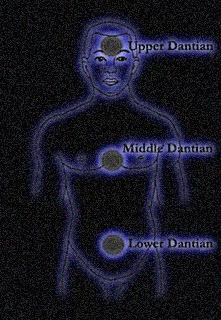
In tai chi chuan circles, when the dantian is mentioned, it is usually the lower dantian (xia dantian) that is being referred to, which is about five or six centimetres (2 – 2.5 inches) below the navel and three or four centimetres (1.5 inches) within the body. After practicing for some time you will naturally sense its location. While practicing tai chi chuan, awareness should be focused on the lower dantian because it is the center of balance and will. It is essential to the principles of a rooted stance, proper breathing, and body awareness. The lower dantian cultivates chi, and intent disperses chi through the body’s meridians. Taoist monks believe that cultivating the lower dantian is crucial; and, if you nurture this field, you will enjoy a long and healthy life. Martial artists regard the lower dantian as the basis of internal power and a source of explosive energy.

The middle dantian (zhong dantian) is in the center of the torso (in line with the heart). It is a repository of chi and is associated with respiration and the health of the internal organs (particularly the thymus gland). The middle dantian is linked to emotional energy.

The upper dantian (shang dantian) is located at the forehead, between the eyes (the ‘third eye’). It is related to consciousness, spirit (shen), and the pituitary gland.

Generally speaking, the development of tai chi chuan practice starts with the cultivation of the lower dantian, moves upward to the middle dantian, and then to the upper dantian (health, emotional balance, spirituality); however, all three dantians are being developed while performing the tai chi chuan forms and other exercises.

.

I’ve been pretty darn lazy the past few months (I’ll blame it on a pseudo-hibernation), but I’m going to attempt to climb out of the funk by getting serious about tai chi again. Posting this is an attempt at motivation…

I’ve been playing tai chi chuan for over twenty years, but still feel like a beginner. Tai chi chuan (tie jee chwahn) is also anglicized as tai ji quan (and various others), and literally means supreme ultimate fist, but is a discipline that has an incredible depth and history (some real, some mythical).

I’ve also dabbled in chi gong (chi kong, qi gong, et cetera), which is very similar to tai chi, but the practitioner is typically rooted to one spot instead of stepping into different postures as in tai chi.

I’m planning on providing a weekly update (with some info-dumps), which should, I hope, work as a catalyst to keep me off the sofa and onto my feet.

I hope it proves interesting to readers as well…