photo credit: © Luc Viatour
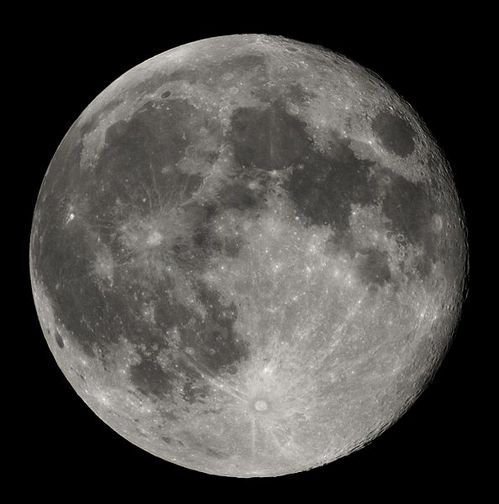
If you’ve ever thought that the moon is further away every day, you’re correct! (And incredibly observant).
The moon’s tidal influence on Earth is causing its orbital radius to increase at a rate of approximately 3.8 centimeters a year.
The side of the Earth that faces the moon is influenced by a greater gravitational pull (due to its proximity) than the center of the planet; conversely, the side of the Earth facing away from the moon is influenced by a lesser gravitational pull than the center of the planet. The result is a stretched, oblong shape to the Earth, but the bulge closer to the moon dominates; and, as a result, a portion of the Earth’s angular momentum is transferred to the moon, thereby increasing its orbital radius.
Theoretical models have predicted that the moon’s orbit will stabilize at a radius approximately 1.6 times the current orbit (of ~385,000 km) in fifteen billion years (give or take a decade here and there). By then, Earth’s day will be fifty-five hours long (the time it will take the moon to orbit the Earth, known as its period).
 db johnston
 almost falling