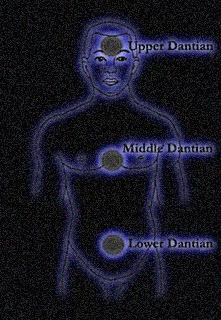
In tai chi chuan circles, when the dantian is mentioned, it is usually the lower dantian (xia dantian) that is being referred to, which is about five or six centimetres (2 – 2.5 inches) below the navel and three or four centimetres (1.5 inches) within the body. After practicing for some time you will naturally sense its location. While practicing tai chi chuan, awareness should be focused on the lower dantian because it is the center of balance and will. It is essential to the principles of a rooted stance, proper breathing, and body awareness. The lower dantian cultivates chi, and intent disperses chi through the body’s meridians. Taoist monks believe that cultivating the lower dantian is crucial; and, if you nurture this field, you will enjoy a long and healthy life. Martial artists regard the lower dantian as the basis of internal power and a source of explosive energy.
The middle dantian (zhong dantian) is in the center of the torso (in line with the heart). It is a repository of chi and is associated with respiration and the health of the internal organs (particularly the thymus gland). The middle dantian is linked to emotional energy.
The upper dantian (shang dantian) is located at the forehead, between the eyes (the ‘third eye’). It is related to consciousness, spirit (shen), and the pituitary gland.
Generally speaking, the development of tai chi chuan practice starts with the cultivation of the lower dantian, moves upward to the middle dantian, and then to the upper dantian (health, emotional balance, spirituality); however, all three dantians are being developed while performing the tai chi chuan forms and other exercises.
.
 db johnston
 almost falling